| With Spring coming, the usual ritual of setting your clocks forward commences. Changing your clocks has been moved up to March 8th this year, and setting them back has been moved to November 1st. Along with setting your clocks forward, now is a good time to remember to change the batteries in your smoke detector. A smoke detector could be the difference between life or death if the inevitable happens. The NFPA has some great tips on the 'Spring Forward, Fall Back' initative. Below are those tips:
*Test your smoke alarms once a month, following the manufacturer's instructions.
*Replace the batteries in your smoke alarms at least once a year or sooner if the alarm "chirps", warning that the battery is slow.
*Never "borrow" a battery from a smoke alarm. Smoke alarms can't warn you of fire if their batteries are missing or have been disconnected.
*Don't disable smoke alarms even temporarily. If your smoke detector is sounding "nuisance alarms," try relocating it farther from the kitchen or bathrooms where cooking fumes or steam can cause the alarm to sound.
*Regularly vacuuming or dusting your smoke alarms will keep them working properly.
*Smoke alarms don't last forever. Replace yours once every 10 years or even sooner if recommended by the manufacturer.
*Those who are deaf or hard of hearing cannot depend on the sound of the regular alarm. Install special alarms for them.
*Recent tests reveal that children, because of the depth of their sleep and other differences in sleep patterns from adults, may not awaken when conventional smoke alarms sound. Insure detectors are place within their bedrooms and evaluate purchasing alternate alarms that are now being produced for children.
*Consider installing smoke alarms with "long-life" (10 year) batteries.
*Plan regular fire drills to ensure that everyone knows exactly what to do when the smoke alarm sounds. Hold drills at night to make sure that sleeping family members react in the correct manner that will save their lives.
Here are some other, good question and answers for smoke detectors in your home.
Why should my home have smoke alarms?
In the event of a fire, a smoke alarm can save your life and those of your loved ones. They are the single most important means of preventing house and apartment fire fatalities by providing an early warning signal, so you and your family can escape. Smoke alarms are one of the best safety features you can buy and install to protect yourself, your family and your home.
It is an unfortunate misconception that people will awaken at the sound or smell of a fire. This is sadly untrue. Oxygen deprived environments, gasses from smoke and burning items affect our ability to react "normally" even if we are light sleepers. Smoke alarms detect smoke in the early stages, giving you and your family the early warning you'll need to get out safely.
Okay, where do I put them?
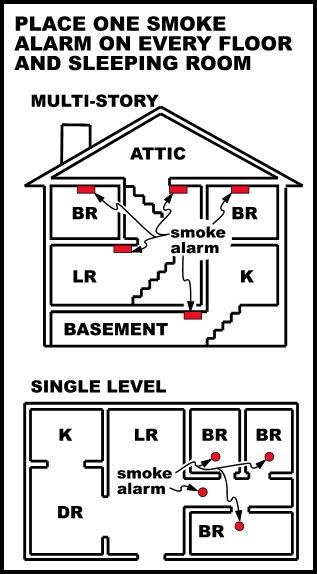
Install smoke alarms on every level of your home, including the basement. Many fatal fires begin late at night or in the early morning. For extra safety, install smoke alarms both inside and outside the sleeping areas. Also, smoke alarms should be installed on the ceiling or 6 to 8 inches below the ceiling on side walls. Since smoke and many deadly gases rise, installing your smoke alarms at the proper level will provide you with the earliest warning possible. Always follow the manufacturer's installation instructions. Smoke detectors sold commercially (packaged) have written and drawn directions on how and where to install smoke detectors.
Where would I get smoke alarms?
Many hardware, home supply or general merchandise stores carry smoke alarms. Make sure the alarm you buy is UL-listed. If you are unsure where to buy one in your community, call your local fire department (on a non-emergency telephone number) and they will provide you with some suggestions.
Are smoke alarms hard to install?
Not a bit. In most cases, all you will need is a screwdriver. Many brands are self-adhesive and will automatically stick to the wall or ceiling where they are placed. However, be sure to follow the directions from the manufacturer because each brand is different. If you are uncomfortable standing on a ladder, ask a relative or friend for help. Call us (non-emergency at (301)-872-5571) if you need help finding someone to install your smoke detectors.
How do I keep my smoke alarms working?
Smoke alarms are very easy to take care of. There are two steps to remember.
Simply replace the batteries at least once a year. We always recommend this occur at the same time you change your clocks for daylight saving time. Meanwhile, if your smoke alarm starts making a "chirping" noise, replace the batteries right away. Also, keep your smoke detector clean—dust and debris can interfere with its operation, so vacuum over and around your smoke alarm regularly. Smoke detector "maintenance" should become a regular maintenance item in your household such as regularly cleaning lint from your dryer.
How often should I check my smoke alarm?
Fire officials and smoke detectors manufacturers recommend that smoke alarms be checked monthly.
What if the alarm goes off while I'm cooking?
Then it's doing its job. Do not disable your smoke alarm if it alarms due to cooking or other non-fire causes. You may not remember to put the batteries back in the alarm after cooking. Instead, clear the air by waving a towel near the alarm, leaving the batteries in place. The alarm may have to be moved to a new location.
How long will my smoke alarm last?
Like most electrical devices, smoke alarms wear out. You may want to write the purchase date with a marker on the inside of your unit. That way, you'll know when to replace it. Always follow the manufacturer's instructions for replacement. Generally speaking, smoke detectors last about eight to ten years, after which they should be replaced
Anything else I should know?
Some smoke alarms are considered to be "hard wired." This means they are connected to the household electrical system and may or may not have battery back-up. As with regular smoke detectors, it is important to test the smoke alarm monthly.
If you don't have a smoke detector, you can contact the station at (301)-872-5571 and ask about obtaining one. |