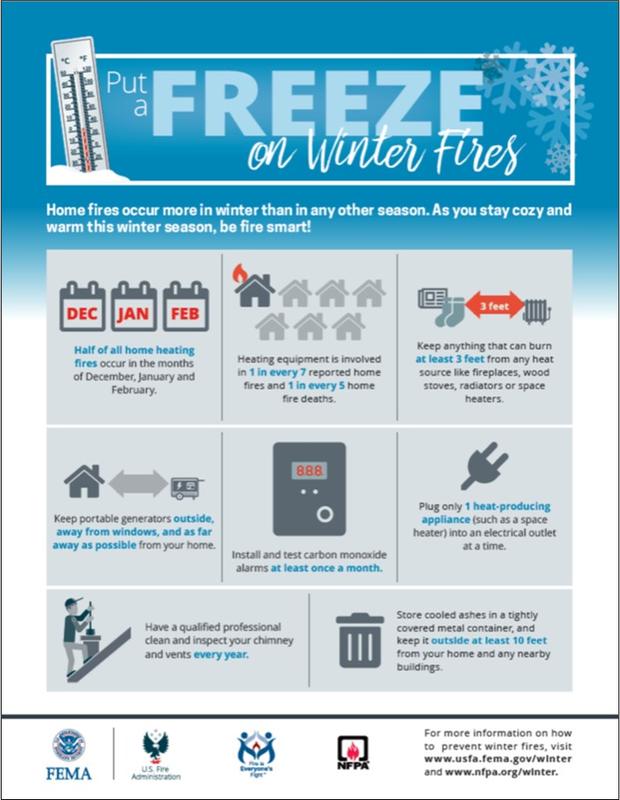
| The threat of winter fires is real. Fifteen percent of all fire deaths occur in January, making it the deadliest month. Additionally, the 2nd week of January is nearly twice as deadly as the rest of the year. It’s important that you understand the severity and prevalence of winter fires:
• Although at its peak in December, residential building fire incidence is collectively highest in the three winter months of January, February, and March.
• 890 people die in winter home fires each year.
• 67% of winter fires occur in one- and two-family homes.
• Winter home fires account for only 8% of the total number of fires in the U.S. but result in 30% of all fire deaths.
• 5:00 p.m. to 8:00 p.m. is the most common time for winter home fires.
• Heating equipment is a leading cause of fires in U.S. homes. Local fire departments responded to an estimated average of 48,530 fires involving heating equipment each year in 2014-2018. These fires resulted in annual losses of 500 civilian deaths, 1,350 civilian injuries, and $1.1 billion in direct property damage.
• Heating equipment caused one in seven home structure fires (14%) that took place in 2014–2018 and 19% of home fire deaths.
• The leading factor contributing to home heating fires (25%) was failure to clean, principally from solid-fueled heating equipment, primarily chimneys.
• Over half (54%) of the home heating fire deaths were caused by having heating equipment too close to things that can burn, such as upholstered furniture, clothing, mattress, or bedding.
• A vast majority of home heating fire deaths (81%) involved stationary or portable space heaters.
• Use of generators and alternative heating sources not only cause an increased fire hazard, they pose the risk of carbon monoxide (CO) poisoning. Only use generators and grills outdoors and away from windows. Never heat your home with a gas stovetop or oven. It is important to make sure CO and smoke alarms are working properly to avoid injury or death.
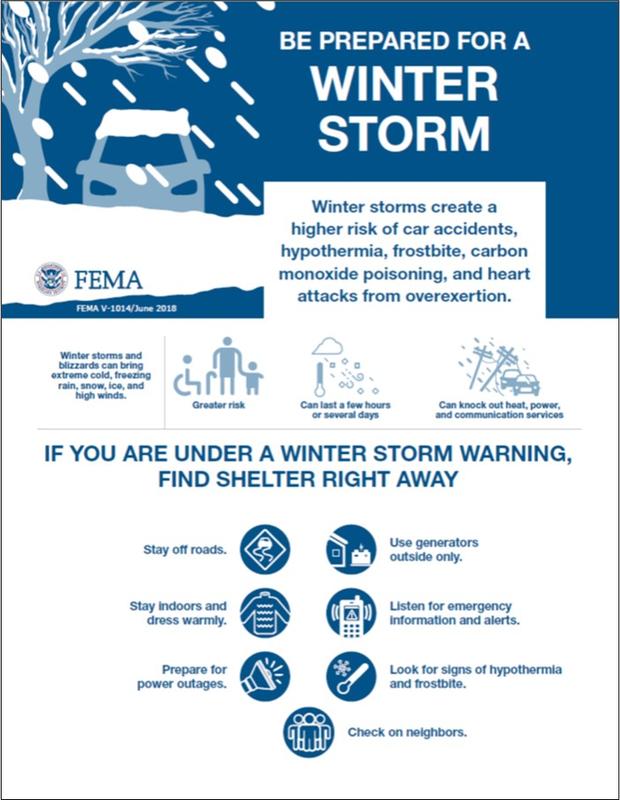
In addition, winter storms create a higher risk of car accidents, hypothermia, frostbite, carbon monoxide poisoning, and heart attacks from overexertion. Winter storms can bring extreme cold, freezing rain, snow, ice and high winds.
Winter storms can:
• Last a few hours or several days.
• Cut off heat, power and communication services.
• Put older adults, children, sick individuals and pets at greater risk.
Prepare your home against fire and CO poisoning by installing and testing smoke alarms and CO detectors. Gather supplies in case you need to stay home for several days without power. Use flashlights instead of candles. Have extra batteries for radios and flashlights. Remember the needs of your pets.
Pay attention to weather reports and warnings of freezing weather and winter storms. Listen for emergency information and alerts. Sign up for your community’s warning system. The Emergency Alert System (EAS) and National Oceanic and Atmospheric Administration (NOAA) Weather Radio also provide emergency alerts.
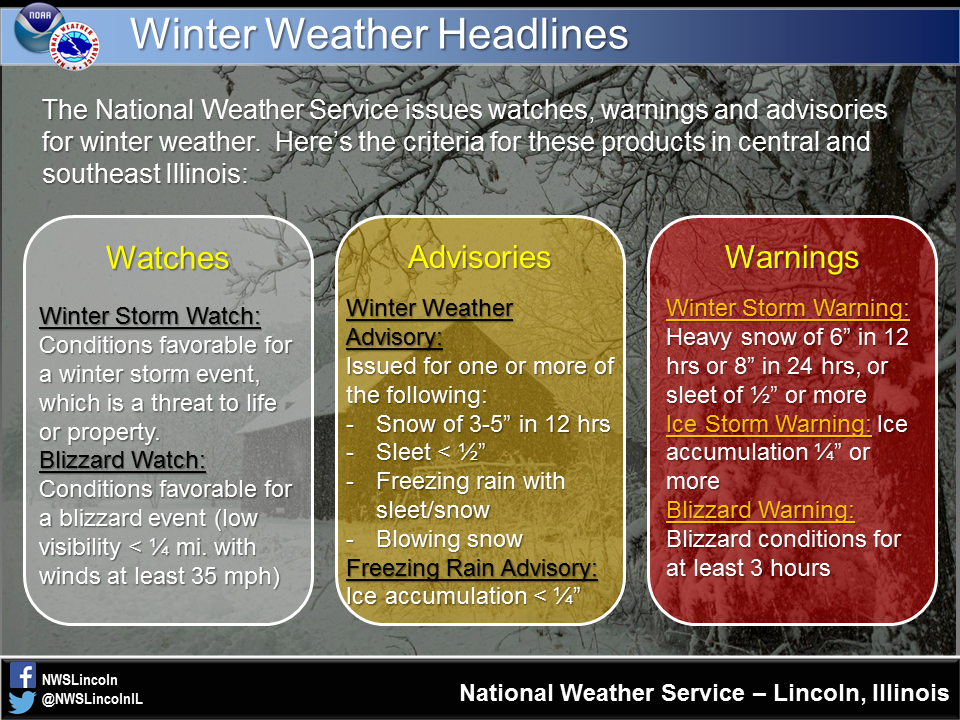
Know your winter weather terms:
• Winter Weather Advisory: Issued for accumulations of snow, freezing rain, freezing drizzle, and sleet which will cause significant inconveniences and, if caution is not exercised, could lead to life-threatening situations.
• Winter Storm Watch: Issued for the possibility of a blizzard, heavy snow, heavy freezing rain, or heavy sleet. Winter Storm Watches are usually issued 12 to 48 hours before the beginning of a Winter Storm.
• Winter Storm Warning: Issued when hazardous winter weather in the form of heavy snow, heavy freezing rain, or heavy sleet is imminent or occurring. Winter Storm Warnings are usually issued 12 to 24 hours before the event is expected to begin.
Be prepared for winter weather at home, at work and in your car. Create an emergency supply kit for your car. Include jumper cables, sand, a flashlight, warm clothes, blankets, bottled water and non-perishable snacks. Keep a full tank of gas.
Stay warm, stay safe!
|